<?xml version="1.0" encoding="utf-8"?><feed xmlns="http://www.w3.org/2005/Atom" ><generator uri="https://jekyllrb.com/" version="3.10.0">Jekyll</generator><link href="https://poeppel-lab.github.io/feed.xml" rel="self" type="application/atom+xml" /><link href="https://poeppel-lab.github.io/" rel="alternate" type="text/html" /><updated>2026-04-29T07:40:14+00:00</updated><id>https://poeppel-lab.github.io/feed.xml</id><title type="html">Poeppel Lab</title><subtitle>personal description</subtitle><author><name>{&quot;avatar&quot;=&gt;nil, &quot;name&quot;=&gt;nil, &quot;pronouns&quot;=&gt;nil, &quot;bio&quot;=&gt;nil, &quot;location&quot;=&gt;nil, &quot;employer&quot;=&gt;nil, &quot;uri&quot;=&gt;nil, &quot;email&quot;=&gt;nil, &quot;arxiv&quot;=&gt;nil, &quot;googlescholar&quot;=&gt;nil, &quot;impactstory&quot;=&gt;nil, &quot;orcid&quot;=&gt;nil, &quot;semantic&quot;=&gt;nil, &quot;pubmed&quot;=&gt;nil, &quot;researchgate&quot;=&gt;nil, &quot;scopus&quot;=&gt;nil, &quot;bitbucket&quot;=&gt;nil, &quot;codepen&quot;=&gt;nil, &quot;dribbble&quot;=&gt;nil, &quot;github&quot;=&gt;nil, &quot;kaggle&quot;=&gt;nil, &quot;stackoverflow&quot;=&gt;nil, &quot;bluesky&quot;=&gt;nil, &quot;facebook&quot;=&gt;nil, &quot;flickr&quot;=&gt;nil, &quot;foursquare&quot;=&gt;nil, &quot;goodreads&quot;=&gt;nil, &quot;google_plus&quot;=&gt;nil, &quot;keybase&quot;=&gt;nil, &quot;instagram&quot;=&gt;nil, &quot;lastfm&quot;=&gt;nil, &quot;linkedin&quot;=&gt;nil, &quot;mastodon&quot;=&gt;nil, &quot;medium&quot;=&gt;nil, &quot;pinterest&quot;=&gt;nil, &quot;soundcloud&quot;=&gt;nil, &quot;steam&quot;=&gt;nil, &quot;telegram&quot;=&gt;nil, &quot;tumblr&quot;=&gt;nil, &quot;twitter&quot;=&gt;nil, &quot;vine&quot;=&gt;nil, &quot;weibo&quot;=&gt;nil, &quot;wikipedia&quot;=&gt;nil, &quot;xing&quot;=&gt;nil, &quot;youtube&quot;=&gt;nil, &quot;zhihu&quot;=&gt;nil}</name></author><entry><title type="html">New paper! (Zou, Poeppel, Ding; Nature Neuroscience, 2026)</title><link href="https://poeppel-lab.github.io/posts/2026/jiajie_nn" rel="alternate" type="text/html" title="New paper! (Zou, Poeppel, Ding; Nature Neuroscience, 2026)" /><published>2026-04-21T00:00:00+00:00</published><updated>2026-04-21T00:00:00+00:00</updated><id>https://poeppel-lab.github.io/posts/2026/jiajie_nn</id><content type="html" xml:base="https://poeppel-lab.github.io/posts/2026/jiajie_nn"><![CDATA[<p>New paper led by Jiajie!</p>
<blockquote>
  <p>Zou J, Poeppel D, Ding N (2026). Constituent-constrained word prediction during language comprehension. Nature Neuroscience.</p>
</blockquote>

<p>Available <a href="https://www.nature.com/articles/s41593-026-02272-6">here</a>.</p>

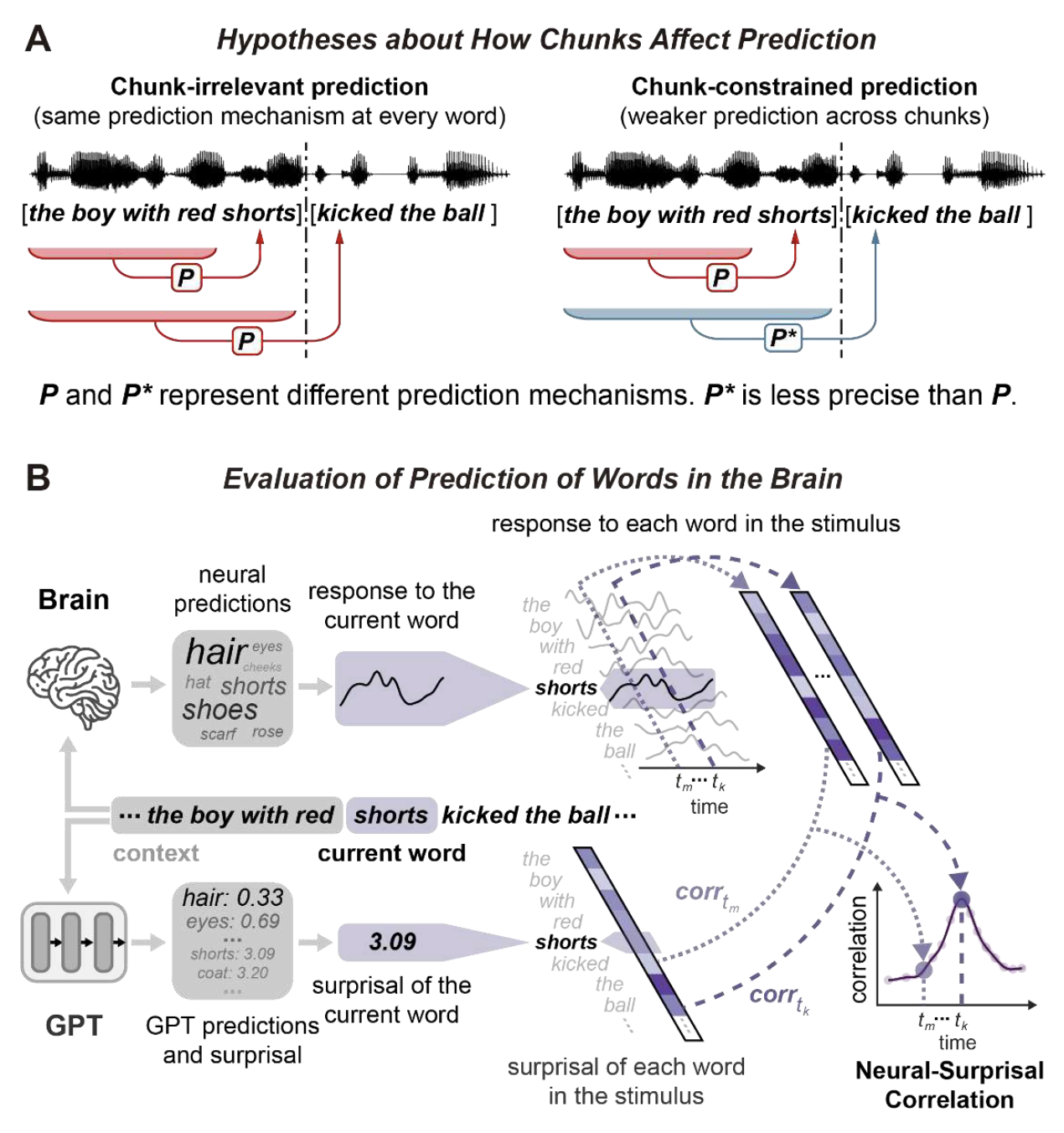
<p>Next-word prediction has been hypothesized as the central computational objective of the human language system, akin to that of current large language models. Here we put this conjecture to the test, investigating whether the brain predicts each upcoming word as precisely as possible when listening to connected speech. In three magnetoencephalography experiments with Mandarin Chinese speakers, we demonstrate that the response related to word unpredictability, that is, word surprisal calculated using large language models, is significantly stronger for words within an ongoing constituent than words across a major constituent boundary, and this effect is further modulated by the certainty of a constituent boundary. This constituent-boundary effect is also observed behaviorally unless speech is very slowly presented, and it is confirmed by analyzing a dataset of electrocorticography responses to natural English narratives. The constituent-boundary effect demonstrates that the language system does not solely optimize word-prediction precision; rather, it balances word-prediction contributions by constituent-constrained management of linguistic contextual representations.</p>]]></content><author><name>{&quot;avatar&quot;=&gt;nil, &quot;name&quot;=&gt;nil, &quot;pronouns&quot;=&gt;nil, &quot;bio&quot;=&gt;nil, &quot;location&quot;=&gt;nil, &quot;employer&quot;=&gt;nil, &quot;uri&quot;=&gt;nil, &quot;email&quot;=&gt;nil, &quot;arxiv&quot;=&gt;nil, &quot;googlescholar&quot;=&gt;nil, &quot;impactstory&quot;=&gt;nil, &quot;orcid&quot;=&gt;nil, &quot;semantic&quot;=&gt;nil, &quot;pubmed&quot;=&gt;nil, &quot;researchgate&quot;=&gt;nil, &quot;scopus&quot;=&gt;nil, &quot;bitbucket&quot;=&gt;nil, &quot;codepen&quot;=&gt;nil, &quot;dribbble&quot;=&gt;nil, &quot;github&quot;=&gt;nil, &quot;kaggle&quot;=&gt;nil, &quot;stackoverflow&quot;=&gt;nil, &quot;bluesky&quot;=&gt;nil, &quot;facebook&quot;=&gt;nil, &quot;flickr&quot;=&gt;nil, &quot;foursquare&quot;=&gt;nil, &quot;goodreads&quot;=&gt;nil, &quot;google_plus&quot;=&gt;nil, &quot;keybase&quot;=&gt;nil, &quot;instagram&quot;=&gt;nil, &quot;lastfm&quot;=&gt;nil, &quot;linkedin&quot;=&gt;nil, &quot;mastodon&quot;=&gt;nil, &quot;medium&quot;=&gt;nil, &quot;pinterest&quot;=&gt;nil, &quot;soundcloud&quot;=&gt;nil, &quot;steam&quot;=&gt;nil, &quot;telegram&quot;=&gt;nil, &quot;tumblr&quot;=&gt;nil, &quot;twitter&quot;=&gt;nil, &quot;vine&quot;=&gt;nil, &quot;weibo&quot;=&gt;nil, &quot;wikipedia&quot;=&gt;nil, &quot;xing&quot;=&gt;nil, &quot;youtube&quot;=&gt;nil, &quot;zhihu&quot;=&gt;nil}</name></author><summary type="html"><![CDATA[New paper led by Jiajie! Zou J, Poeppel D, Ding N (2026). Constituent-constrained word prediction during language comprehension. Nature Neuroscience. Available here. Next-word prediction has been hypothesized as the central computational objective of the human language system, akin to that of current large language models. Here we put this conjecture to the test, investigating whether the brain predicts each upcoming word as precisely as possible when listening to connected speech. In three magnetoencephalography experiments with Mandarin Chinese speakers, we demonstrate that the response related to word unpredictability, that is, word surprisal calculated using large language models, is significantly stronger for words within an ongoing constituent than words across a major constituent boundary, and this effect is further modulated by the certainty of a constituent boundary. This constituent-boundary effect is also observed behaviorally unless speech is very slowly presented, and it is confirmed by analyzing a dataset of electrocorticography responses to natural English narratives. The constituent-boundary effect demonstrates that the language system does not solely optimize word-prediction precision; rather, it balances word-prediction contributions by constituent-constrained management of linguistic contextual representations.]]></summary></entry><entry><title type="html">New preprint! (García-Rosales et al., 2026)</title><link href="https://poeppel-lab.github.io/posts/2026/garcia_biorxiv" rel="alternate" type="text/html" title="New preprint! (García-Rosales et al., 2026)" /><published>2026-01-15T00:00:00+00:00</published><updated>2026-01-15T00:00:00+00:00</updated><id>https://poeppel-lab.github.io/posts/2026/garcia_preprint</id><content type="html" xml:base="https://poeppel-lab.github.io/posts/2026/garcia_biorxiv"><![CDATA[<p>New preprint from Francisco!</p>
<blockquote>
  <p>García-Rosales F, Sotomayor-Gomez B, Poeppel D, Hechavarria JC (2026). Vocal production differentially affects fast-and broad-spiking neurons in auditory cortex. bioRxiv.</p>
</blockquote>

<p>Available <a href="https://www.biorxiv.org/content/10.64898/2026.01.15.699648v1">here</a>.</p>

<p>Vocalization, foundational for information exchange in animals, is supported by vocalization-modulated neurons that occur across species and brain areas. These neurons are typically studied in an undifferentiated manner, despite the heterogeneous nature of the cortical circuitry regarding cell types. Overlooking this diversity risks producing incomplete models of cortical function. Here, we address this challenge by studying large-scale, cell-type specific auditory cortical activity during vocalization in the bat Carollia perspicillata, a vocal specialist. We discovered that vocalisation-related modulatory effects in the auditory cortex, a critical attribute of the underlying circuit, differ starkly between putative inhibitory and pyramidal neurons. During calling, novel cell assemblies and temporal spiking patterns emerge wherein inhibitory cells play a pivotal role. Further, vocalization-specific neural decorrelations affect inhibitory cells most strongly. Together, these results demonstrate that vocalization-related neuronal activity is cell-type specific at the single- and multi-cellular levels of cortical organisation and highlight the importance of inhibitory neurons for auditory cortical dynamics during vocal production.</p>]]></content><author><name>{&quot;avatar&quot;=&gt;nil, &quot;name&quot;=&gt;nil, &quot;pronouns&quot;=&gt;nil, &quot;bio&quot;=&gt;nil, &quot;location&quot;=&gt;nil, &quot;employer&quot;=&gt;nil, &quot;uri&quot;=&gt;nil, &quot;email&quot;=&gt;nil, &quot;arxiv&quot;=&gt;nil, &quot;googlescholar&quot;=&gt;nil, &quot;impactstory&quot;=&gt;nil, &quot;orcid&quot;=&gt;nil, &quot;semantic&quot;=&gt;nil, &quot;pubmed&quot;=&gt;nil, &quot;researchgate&quot;=&gt;nil, &quot;scopus&quot;=&gt;nil, &quot;bitbucket&quot;=&gt;nil, &quot;codepen&quot;=&gt;nil, &quot;dribbble&quot;=&gt;nil, &quot;github&quot;=&gt;nil, &quot;kaggle&quot;=&gt;nil, &quot;stackoverflow&quot;=&gt;nil, &quot;bluesky&quot;=&gt;nil, &quot;facebook&quot;=&gt;nil, &quot;flickr&quot;=&gt;nil, &quot;foursquare&quot;=&gt;nil, &quot;goodreads&quot;=&gt;nil, &quot;google_plus&quot;=&gt;nil, &quot;keybase&quot;=&gt;nil, &quot;instagram&quot;=&gt;nil, &quot;lastfm&quot;=&gt;nil, &quot;linkedin&quot;=&gt;nil, &quot;mastodon&quot;=&gt;nil, &quot;medium&quot;=&gt;nil, &quot;pinterest&quot;=&gt;nil, &quot;soundcloud&quot;=&gt;nil, &quot;steam&quot;=&gt;nil, &quot;telegram&quot;=&gt;nil, &quot;tumblr&quot;=&gt;nil, &quot;twitter&quot;=&gt;nil, &quot;vine&quot;=&gt;nil, &quot;weibo&quot;=&gt;nil, &quot;wikipedia&quot;=&gt;nil, &quot;xing&quot;=&gt;nil, &quot;youtube&quot;=&gt;nil, &quot;zhihu&quot;=&gt;nil}</name></author><summary type="html"><![CDATA[New preprint from Francisco! García-Rosales F, Sotomayor-Gomez B, Poeppel D, Hechavarria JC (2026). Vocal production differentially affects fast-and broad-spiking neurons in auditory cortex. bioRxiv. Available here. Vocalization, foundational for information exchange in animals, is supported by vocalization-modulated neurons that occur across species and brain areas. These neurons are typically studied in an undifferentiated manner, despite the heterogeneous nature of the cortical circuitry regarding cell types. Overlooking this diversity risks producing incomplete models of cortical function. Here, we address this challenge by studying large-scale, cell-type specific auditory cortical activity during vocalization in the bat Carollia perspicillata, a vocal specialist. We discovered that vocalisation-related modulatory effects in the auditory cortex, a critical attribute of the underlying circuit, differ starkly between putative inhibitory and pyramidal neurons. During calling, novel cell assemblies and temporal spiking patterns emerge wherein inhibitory cells play a pivotal role. Further, vocalization-specific neural decorrelations affect inhibitory cells most strongly. Together, these results demonstrate that vocalization-related neuronal activity is cell-type specific at the single- and multi-cellular levels of cortical organisation and highlight the importance of inhibitory neurons for auditory cortical dynamics during vocal production.]]></summary></entry><entry><title type="html">New preprint! (Bastug et al., 2026)</title><link href="https://poeppel-lab.github.io/posts/2026/bastug_biorxiv" rel="alternate" type="text/html" title="New preprint! (Bastug et al., 2026)" /><published>2026-01-14T00:00:00+00:00</published><updated>2026-01-14T00:00:00+00:00</updated><id>https://poeppel-lab.github.io/posts/2026/bastug_preprint</id><content type="html" xml:base="https://poeppel-lab.github.io/posts/2026/bastug_biorxiv"><![CDATA[<p>New preprint from Berfin!</p>
<blockquote>
  <p>Bastug B, Sun Y, Adolfi F, Schröger E, Poeppel D (2026). Repetition Coherence Reveals Computational Principles of Auditory Object Formation. bioRxiv.</p>
</blockquote>

<p>Available <a href="https://www.biorxiv.org/content/10.64898/2026.01.14.699508v1">here</a>.</p>

<p>Repetition is a powerful cue for auditory object formation. In natural environments, however, repetitions are rarely exact copies of sound sequences and often overlap with competing sounds. To characterise the temporal integration dynamics and the evidence required for perceptual organisation of acoustic scenes into objects, we developed a repetition-coherence framework inspired by motion-coherence paradigms in vision. Participants listened to dense tone-cloud sequences in which a subset of tones repeated across cycles, with the proportion of repeating tones indicating coherence. Across two psychophysical tasks (repetition detection and sensorimotor synchronization), repetition coherence had strikingly similar effects: it shaped both the likelihood of object formation and the consistency of subsequent tracking. At high coherence, the emergence of the object and the attainment of a stable tracking phase occurred at the same number of cycles. The behavioural trajectory of synchronization performance, used to infer the dynamics of temporal integration, parallels prior neurophysiological findings in non-human primates, establishing a link between perception and neurophysiology. Moreover, we observed threshold shifts due to unit duration in the detection task, which indicates a dissociation between the effect of temporal scale on the likelihood and timing of object emergence: longer units when repeated reduced detection probability, but emergence timing remained constant. These findings demonstrate convergent behavioural dynamics shaped by bottom-up regularities, while intrinsic temporal integration windows constrain the process differently according to task demands. Overall, repetition coherence provides a principled framework for probing the processes underpinning auditory object formation, revealing common behavioural signatures alongside distinct sensitivities to temporal scale.</p>]]></content><author><name>{&quot;avatar&quot;=&gt;nil, &quot;name&quot;=&gt;nil, &quot;pronouns&quot;=&gt;nil, &quot;bio&quot;=&gt;nil, &quot;location&quot;=&gt;nil, &quot;employer&quot;=&gt;nil, &quot;uri&quot;=&gt;nil, &quot;email&quot;=&gt;nil, &quot;arxiv&quot;=&gt;nil, &quot;googlescholar&quot;=&gt;nil, &quot;impactstory&quot;=&gt;nil, &quot;orcid&quot;=&gt;nil, &quot;semantic&quot;=&gt;nil, &quot;pubmed&quot;=&gt;nil, &quot;researchgate&quot;=&gt;nil, &quot;scopus&quot;=&gt;nil, &quot;bitbucket&quot;=&gt;nil, &quot;codepen&quot;=&gt;nil, &quot;dribbble&quot;=&gt;nil, &quot;github&quot;=&gt;nil, &quot;kaggle&quot;=&gt;nil, &quot;stackoverflow&quot;=&gt;nil, &quot;bluesky&quot;=&gt;nil, &quot;facebook&quot;=&gt;nil, &quot;flickr&quot;=&gt;nil, &quot;foursquare&quot;=&gt;nil, &quot;goodreads&quot;=&gt;nil, &quot;google_plus&quot;=&gt;nil, &quot;keybase&quot;=&gt;nil, &quot;instagram&quot;=&gt;nil, &quot;lastfm&quot;=&gt;nil, &quot;linkedin&quot;=&gt;nil, &quot;mastodon&quot;=&gt;nil, &quot;medium&quot;=&gt;nil, &quot;pinterest&quot;=&gt;nil, &quot;soundcloud&quot;=&gt;nil, &quot;steam&quot;=&gt;nil, &quot;telegram&quot;=&gt;nil, &quot;tumblr&quot;=&gt;nil, &quot;twitter&quot;=&gt;nil, &quot;vine&quot;=&gt;nil, &quot;weibo&quot;=&gt;nil, &quot;wikipedia&quot;=&gt;nil, &quot;xing&quot;=&gt;nil, &quot;youtube&quot;=&gt;nil, &quot;zhihu&quot;=&gt;nil}</name></author><summary type="html"><![CDATA[New preprint from Berfin! Bastug B, Sun Y, Adolfi F, Schröger E, Poeppel D (2026). Repetition Coherence Reveals Computational Principles of Auditory Object Formation. bioRxiv. Available here. Repetition is a powerful cue for auditory object formation. In natural environments, however, repetitions are rarely exact copies of sound sequences and often overlap with competing sounds. To characterise the temporal integration dynamics and the evidence required for perceptual organisation of acoustic scenes into objects, we developed a repetition-coherence framework inspired by motion-coherence paradigms in vision. Participants listened to dense tone-cloud sequences in which a subset of tones repeated across cycles, with the proportion of repeating tones indicating coherence. Across two psychophysical tasks (repetition detection and sensorimotor synchronization), repetition coherence had strikingly similar effects: it shaped both the likelihood of object formation and the consistency of subsequent tracking. At high coherence, the emergence of the object and the attainment of a stable tracking phase occurred at the same number of cycles. The behavioural trajectory of synchronization performance, used to infer the dynamics of temporal integration, parallels prior neurophysiological findings in non-human primates, establishing a link between perception and neurophysiology. Moreover, we observed threshold shifts due to unit duration in the detection task, which indicates a dissociation between the effect of temporal scale on the likelihood and timing of object emergence: longer units when repeated reduced detection probability, but emergence timing remained constant. These findings demonstrate convergent behavioural dynamics shaped by bottom-up regularities, while intrinsic temporal integration windows constrain the process differently according to task demands. Overall, repetition coherence provides a principled framework for probing the processes underpinning auditory object formation, revealing common behavioural signatures alongside distinct sensitivities to temporal scale.]]></summary></entry><entry><title type="html">New paper! (Grabenhorst et al., PNAS, 2026)</title><link href="https://poeppel-lab.github.io/posts/2026/paper_grabenhorst" rel="alternate" type="text/html" title="New paper! (Grabenhorst et al., PNAS, 2026)" /><published>2026-01-13T00:00:00+00:00</published><updated>2026-01-13T00:00:00+00:00</updated><id>https://poeppel-lab.github.io/posts/2026/grabenhorst</id><content type="html" xml:base="https://poeppel-lab.github.io/posts/2026/paper_grabenhorst"><![CDATA[<p>New paper led by Matthias!</p>
<blockquote>
  <p>Grabenhorst M, Poeppel D, Michalareas G (2026). The anticipation of imminent events is time-scale invariant. Proceedings of the National Academy of Sciences.</p>
</blockquote>

<p>Available <a href="https://www.pnas.org/doi/10.1073/pnas.2518982123">here</a>.</p>

<p>From everyday conversation to sports, to traffic, to music, people constantly predict when events will happen so they can prepare their next actions. This study examines how the brain makes such timing predictions over short periods of a few seconds. Using experiments with vision and audition, along with models of reaction times, we found that people rely on the same underlying calculation regardless of the time scale: They estimate the probability of an event over time. This process drives anticipation and determines how precise anticipation is, consistently across time scales. Our results suggest that this scale invariance is a basic principle of how humans anticipate events in time—a core function that supports many aspects of thought and behavior.</p>]]></content><author><name>{&quot;avatar&quot;=&gt;nil, &quot;name&quot;=&gt;nil, &quot;pronouns&quot;=&gt;nil, &quot;bio&quot;=&gt;nil, &quot;location&quot;=&gt;nil, &quot;employer&quot;=&gt;nil, &quot;uri&quot;=&gt;nil, &quot;email&quot;=&gt;nil, &quot;arxiv&quot;=&gt;nil, &quot;googlescholar&quot;=&gt;nil, &quot;impactstory&quot;=&gt;nil, &quot;orcid&quot;=&gt;nil, &quot;semantic&quot;=&gt;nil, &quot;pubmed&quot;=&gt;nil, &quot;researchgate&quot;=&gt;nil, &quot;scopus&quot;=&gt;nil, &quot;bitbucket&quot;=&gt;nil, &quot;codepen&quot;=&gt;nil, &quot;dribbble&quot;=&gt;nil, &quot;github&quot;=&gt;nil, &quot;kaggle&quot;=&gt;nil, &quot;stackoverflow&quot;=&gt;nil, &quot;bluesky&quot;=&gt;nil, &quot;facebook&quot;=&gt;nil, &quot;flickr&quot;=&gt;nil, &quot;foursquare&quot;=&gt;nil, &quot;goodreads&quot;=&gt;nil, &quot;google_plus&quot;=&gt;nil, &quot;keybase&quot;=&gt;nil, &quot;instagram&quot;=&gt;nil, &quot;lastfm&quot;=&gt;nil, &quot;linkedin&quot;=&gt;nil, &quot;mastodon&quot;=&gt;nil, &quot;medium&quot;=&gt;nil, &quot;pinterest&quot;=&gt;nil, &quot;soundcloud&quot;=&gt;nil, &quot;steam&quot;=&gt;nil, &quot;telegram&quot;=&gt;nil, &quot;tumblr&quot;=&gt;nil, &quot;twitter&quot;=&gt;nil, &quot;vine&quot;=&gt;nil, &quot;weibo&quot;=&gt;nil, &quot;wikipedia&quot;=&gt;nil, &quot;xing&quot;=&gt;nil, &quot;youtube&quot;=&gt;nil, &quot;zhihu&quot;=&gt;nil}</name></author><summary type="html"><![CDATA[New paper led by Matthias! Grabenhorst M, Poeppel D, Michalareas G (2026). The anticipation of imminent events is time-scale invariant. Proceedings of the National Academy of Sciences. Available here. From everyday conversation to sports, to traffic, to music, people constantly predict when events will happen so they can prepare their next actions. This study examines how the brain makes such timing predictions over short periods of a few seconds. Using experiments with vision and audition, along with models of reaction times, we found that people rely on the same underlying calculation regardless of the time scale: They estimate the probability of an event over time. This process drives anticipation and determines how precise anticipation is, consistently across time scales. Our results suggest that this scale invariance is a basic principle of how humans anticipate events in time—a core function that supports many aspects of thought and behavior.]]></summary></entry><entry><title type="html">New comment! (van Bree &amp;amp; Poeppel, Nature Reviews Neuroscience, 2025)</title><link href="https://poeppel-lab.github.io/posts/2025/van_bree_nrn" rel="alternate" type="text/html" title="New comment! (van Bree &amp;amp; Poeppel, Nature Reviews Neuroscience, 2025)" /><published>2025-12-02T00:00:00+00:00</published><updated>2025-12-02T00:00:00+00:00</updated><id>https://poeppel-lab.github.io/posts/2025/van_bree_nrn</id><content type="html" xml:base="https://poeppel-lab.github.io/posts/2025/van_bree_nrn"><![CDATA[<p>New comment from Sander van Bree and David published in <em>Nature Reviews Neuroscience</em>!</p>
<blockquote>
  <p>van Bree S, Poeppel D (2025). Top-down and bottom-up neuroscience as collections of practices. Nature Reviews Neuroscience.</p>
</blockquote>

<p>Available <a href="https://www.nature.com/articles/s41583-025-01004-2">here</a>.</p>]]></content><author><name>{&quot;avatar&quot;=&gt;nil, &quot;name&quot;=&gt;nil, &quot;pronouns&quot;=&gt;nil, &quot;bio&quot;=&gt;nil, &quot;location&quot;=&gt;nil, &quot;employer&quot;=&gt;nil, &quot;uri&quot;=&gt;nil, &quot;email&quot;=&gt;nil, &quot;arxiv&quot;=&gt;nil, &quot;googlescholar&quot;=&gt;nil, &quot;impactstory&quot;=&gt;nil, &quot;orcid&quot;=&gt;nil, &quot;semantic&quot;=&gt;nil, &quot;pubmed&quot;=&gt;nil, &quot;researchgate&quot;=&gt;nil, &quot;scopus&quot;=&gt;nil, &quot;bitbucket&quot;=&gt;nil, &quot;codepen&quot;=&gt;nil, &quot;dribbble&quot;=&gt;nil, &quot;github&quot;=&gt;nil, &quot;kaggle&quot;=&gt;nil, &quot;stackoverflow&quot;=&gt;nil, &quot;bluesky&quot;=&gt;nil, &quot;facebook&quot;=&gt;nil, &quot;flickr&quot;=&gt;nil, &quot;foursquare&quot;=&gt;nil, &quot;goodreads&quot;=&gt;nil, &quot;google_plus&quot;=&gt;nil, &quot;keybase&quot;=&gt;nil, &quot;instagram&quot;=&gt;nil, &quot;lastfm&quot;=&gt;nil, &quot;linkedin&quot;=&gt;nil, &quot;mastodon&quot;=&gt;nil, &quot;medium&quot;=&gt;nil, &quot;pinterest&quot;=&gt;nil, &quot;soundcloud&quot;=&gt;nil, &quot;steam&quot;=&gt;nil, &quot;telegram&quot;=&gt;nil, &quot;tumblr&quot;=&gt;nil, &quot;twitter&quot;=&gt;nil, &quot;vine&quot;=&gt;nil, &quot;weibo&quot;=&gt;nil, &quot;wikipedia&quot;=&gt;nil, &quot;xing&quot;=&gt;nil, &quot;youtube&quot;=&gt;nil, &quot;zhihu&quot;=&gt;nil}</name></author><summary type="html"><![CDATA[New comment from Sander van Bree and David published in Nature Reviews Neuroscience! van Bree S, Poeppel D (2025). Top-down and bottom-up neuroscience as collections of practices. Nature Reviews Neuroscience. Available here.]]></summary></entry><entry><title type="html">New paper! (Raccah et al., iScience, 2025)</title><link href="https://poeppel-lab.github.io/posts/2025/raccah_iscience" rel="alternate" type="text/html" title="New paper! (Raccah et al., iScience, 2025)" /><published>2025-11-21T00:00:00+00:00</published><updated>2025-11-21T00:00:00+00:00</updated><id>https://poeppel-lab.github.io/posts/2025/raccah_iscience</id><content type="html" xml:base="https://poeppel-lab.github.io/posts/2025/raccah_iscience"><![CDATA[<p>New paper from Omri published in <em>iScience</em>!</p>
<blockquote>
  <p>Raccah O, Seltenreich M, Pelofi C, Lerdahl F, Poeppel D (2025). Geometric properties of musical scales constitute a representational primitive in melodic processing. iScience.</p>
</blockquote>

<p>Available <a href="https://www.sciencedirect.com/science/article/pii/S2589004225019625">here</a>.</p>

<ul>
  <li>Data from hundreds of participants elucidates how musical scales shape perception</li>
  <li>The geometry underlying scales influences perceptual sensitivity to note deviations</li>
  <li>Geometric regularity predicts perceptual sensitivity across diverse structures</li>
  <li>Effects persist in the absence of a familiar tuning system</li>
</ul>]]></content><author><name>{&quot;avatar&quot;=&gt;nil, &quot;name&quot;=&gt;nil, &quot;pronouns&quot;=&gt;nil, &quot;bio&quot;=&gt;nil, &quot;location&quot;=&gt;nil, &quot;employer&quot;=&gt;nil, &quot;uri&quot;=&gt;nil, &quot;email&quot;=&gt;nil, &quot;arxiv&quot;=&gt;nil, &quot;googlescholar&quot;=&gt;nil, &quot;impactstory&quot;=&gt;nil, &quot;orcid&quot;=&gt;nil, &quot;semantic&quot;=&gt;nil, &quot;pubmed&quot;=&gt;nil, &quot;researchgate&quot;=&gt;nil, &quot;scopus&quot;=&gt;nil, &quot;bitbucket&quot;=&gt;nil, &quot;codepen&quot;=&gt;nil, &quot;dribbble&quot;=&gt;nil, &quot;github&quot;=&gt;nil, &quot;kaggle&quot;=&gt;nil, &quot;stackoverflow&quot;=&gt;nil, &quot;bluesky&quot;=&gt;nil, &quot;facebook&quot;=&gt;nil, &quot;flickr&quot;=&gt;nil, &quot;foursquare&quot;=&gt;nil, &quot;goodreads&quot;=&gt;nil, &quot;google_plus&quot;=&gt;nil, &quot;keybase&quot;=&gt;nil, &quot;instagram&quot;=&gt;nil, &quot;lastfm&quot;=&gt;nil, &quot;linkedin&quot;=&gt;nil, &quot;mastodon&quot;=&gt;nil, &quot;medium&quot;=&gt;nil, &quot;pinterest&quot;=&gt;nil, &quot;soundcloud&quot;=&gt;nil, &quot;steam&quot;=&gt;nil, &quot;telegram&quot;=&gt;nil, &quot;tumblr&quot;=&gt;nil, &quot;twitter&quot;=&gt;nil, &quot;vine&quot;=&gt;nil, &quot;weibo&quot;=&gt;nil, &quot;wikipedia&quot;=&gt;nil, &quot;xing&quot;=&gt;nil, &quot;youtube&quot;=&gt;nil, &quot;zhihu&quot;=&gt;nil}</name></author><summary type="html"><![CDATA[New paper from Omri published in iScience! Raccah O, Seltenreich M, Pelofi C, Lerdahl F, Poeppel D (2025). Geometric properties of musical scales constitute a representational primitive in melodic processing. iScience. Available here. Data from hundreds of participants elucidates how musical scales shape perception The geometry underlying scales influences perceptual sensitivity to note deviations Geometric regularity predicts perceptual sensitivity across diverse structures Effects persist in the absence of a familiar tuning system]]></summary></entry><entry><title type="html">David receives Grafstein Award for Mentoring</title><link href="https://poeppel-lab.github.io/posts/2025/grafstein_award" rel="alternate" type="text/html" title="David receives Grafstein Award for Mentoring" /><published>2025-11-17T00:00:00+00:00</published><updated>2025-11-17T00:00:00+00:00</updated><id>https://poeppel-lab.github.io/posts/2025/mentoring_award</id><content type="html" xml:base="https://poeppel-lab.github.io/posts/2025/grafstein_award"><![CDATA[<p>David received the 2025 <a href="https://www.sfn.org/initiatives/women-and-neuroscience/awards">Bernice Grafstein Award for Outstanding Accomplishments in Mentoring</a> from the Society of Neuroscience.</p>

<p><img src="/images/2025_grafstein.jpg" alt="" /></p>]]></content><author><name>{&quot;avatar&quot;=&gt;nil, &quot;name&quot;=&gt;nil, &quot;pronouns&quot;=&gt;nil, &quot;bio&quot;=&gt;nil, &quot;location&quot;=&gt;nil, &quot;employer&quot;=&gt;nil, &quot;uri&quot;=&gt;nil, &quot;email&quot;=&gt;nil, &quot;arxiv&quot;=&gt;nil, &quot;googlescholar&quot;=&gt;nil, &quot;impactstory&quot;=&gt;nil, &quot;orcid&quot;=&gt;nil, &quot;semantic&quot;=&gt;nil, &quot;pubmed&quot;=&gt;nil, &quot;researchgate&quot;=&gt;nil, &quot;scopus&quot;=&gt;nil, &quot;bitbucket&quot;=&gt;nil, &quot;codepen&quot;=&gt;nil, &quot;dribbble&quot;=&gt;nil, &quot;github&quot;=&gt;nil, &quot;kaggle&quot;=&gt;nil, &quot;stackoverflow&quot;=&gt;nil, &quot;bluesky&quot;=&gt;nil, &quot;facebook&quot;=&gt;nil, &quot;flickr&quot;=&gt;nil, &quot;foursquare&quot;=&gt;nil, &quot;goodreads&quot;=&gt;nil, &quot;google_plus&quot;=&gt;nil, &quot;keybase&quot;=&gt;nil, &quot;instagram&quot;=&gt;nil, &quot;lastfm&quot;=&gt;nil, &quot;linkedin&quot;=&gt;nil, &quot;mastodon&quot;=&gt;nil, &quot;medium&quot;=&gt;nil, &quot;pinterest&quot;=&gt;nil, &quot;soundcloud&quot;=&gt;nil, &quot;steam&quot;=&gt;nil, &quot;telegram&quot;=&gt;nil, &quot;tumblr&quot;=&gt;nil, &quot;twitter&quot;=&gt;nil, &quot;vine&quot;=&gt;nil, &quot;weibo&quot;=&gt;nil, &quot;wikipedia&quot;=&gt;nil, &quot;xing&quot;=&gt;nil, &quot;youtube&quot;=&gt;nil, &quot;zhihu&quot;=&gt;nil}</name></author><summary type="html"><![CDATA[David received the 2025 Bernice Grafstein Award for Outstanding Accomplishments in Mentoring from the Society of Neuroscience.]]></summary></entry><entry><title type="html">New paper! (Bastug et al., Cognition, 2026)</title><link href="https://poeppel-lab.github.io/posts/2025/bastug_cognition" rel="alternate" type="text/html" title="New paper! (Bastug et al., Cognition, 2026)" /><published>2025-11-14T00:00:00+00:00</published><updated>2025-11-14T00:00:00+00:00</updated><id>https://poeppel-lab.github.io/posts/2025/bastug_cognition</id><content type="html" xml:base="https://poeppel-lab.github.io/posts/2025/bastug_cognition"><![CDATA[<p>New paper from Berfin published in <em>Cognition</em>!</p>
<blockquote>
  <p>Bastug D, Rajendran VG, Bianco R, Agus T, Chait M, Pressnitzer D (2026). Memory for repeated auditory textures. Cognition.</p>
</blockquote>

<p>Available <a href="https://www.sciencedirect.com/science/article/pii/S0010027725002914">here</a>.</p>

<ul>
  <li>Individual exemplars of natural auditory textures can be memorized when repeated.</li>
  <li>Temporally local features can co-exist with time-averaged summary statistics in the representations of natural textures.</li>
  <li>Multi-scale representations of complex sounds could be an efficient way to adapt to different task demands.</li>
</ul>]]></content><author><name>{&quot;avatar&quot;=&gt;nil, &quot;name&quot;=&gt;nil, &quot;pronouns&quot;=&gt;nil, &quot;bio&quot;=&gt;nil, &quot;location&quot;=&gt;nil, &quot;employer&quot;=&gt;nil, &quot;uri&quot;=&gt;nil, &quot;email&quot;=&gt;nil, &quot;arxiv&quot;=&gt;nil, &quot;googlescholar&quot;=&gt;nil, &quot;impactstory&quot;=&gt;nil, &quot;orcid&quot;=&gt;nil, &quot;semantic&quot;=&gt;nil, &quot;pubmed&quot;=&gt;nil, &quot;researchgate&quot;=&gt;nil, &quot;scopus&quot;=&gt;nil, &quot;bitbucket&quot;=&gt;nil, &quot;codepen&quot;=&gt;nil, &quot;dribbble&quot;=&gt;nil, &quot;github&quot;=&gt;nil, &quot;kaggle&quot;=&gt;nil, &quot;stackoverflow&quot;=&gt;nil, &quot;bluesky&quot;=&gt;nil, &quot;facebook&quot;=&gt;nil, &quot;flickr&quot;=&gt;nil, &quot;foursquare&quot;=&gt;nil, &quot;goodreads&quot;=&gt;nil, &quot;google_plus&quot;=&gt;nil, &quot;keybase&quot;=&gt;nil, &quot;instagram&quot;=&gt;nil, &quot;lastfm&quot;=&gt;nil, &quot;linkedin&quot;=&gt;nil, &quot;mastodon&quot;=&gt;nil, &quot;medium&quot;=&gt;nil, &quot;pinterest&quot;=&gt;nil, &quot;soundcloud&quot;=&gt;nil, &quot;steam&quot;=&gt;nil, &quot;telegram&quot;=&gt;nil, &quot;tumblr&quot;=&gt;nil, &quot;twitter&quot;=&gt;nil, &quot;vine&quot;=&gt;nil, &quot;weibo&quot;=&gt;nil, &quot;wikipedia&quot;=&gt;nil, &quot;xing&quot;=&gt;nil, &quot;youtube&quot;=&gt;nil, &quot;zhihu&quot;=&gt;nil}</name></author><summary type="html"><![CDATA[New paper from Berfin published in Cognition! Bastug D, Rajendran VG, Bianco R, Agus T, Chait M, Pressnitzer D (2026). Memory for repeated auditory textures. Cognition. Available here. Individual exemplars of natural auditory textures can be memorized when repeated. Temporally local features can co-exist with time-averaged summary statistics in the representations of natural textures. Multi-scale representations of complex sounds could be an efficient way to adapt to different task demands.]]></summary></entry><entry><title type="html">Lab @ Timing Research Forum 4</title><link href="https://poeppel-lab.github.io/posts/2025/trf4" rel="alternate" type="text/html" title="Lab @ Timing Research Forum 4" /><published>2025-10-14T00:00:00+00:00</published><updated>2025-10-14T00:00:00+00:00</updated><id>https://poeppel-lab.github.io/posts/2025/trf4</id><content type="html" xml:base="https://poeppel-lab.github.io/posts/2025/trf4"><![CDATA[<p>Find lab members at the <a href="https://sites.google.com/view/trf4tokyo/home">Timing Research Forum 4</a> in Tokyo!</p>

<ul>
  <li>(O6-02): Matthias Grabenhorst – The anticipation of imminent events is time-scale invariant.</li>
  <li>(O8-01): Leonardo Zeine – Towards Differentiating Endogenously and Exogenously Driven Rhythms in the Brain: Syntax, Prosody and Delta-Band Activity</li>
  <li>(P3-04): Yue Sun – Complex impact of stimulus envelope on motor synchronization to sound</li>
  <li>(P3-23): Berfin Bastug – Auditory Object Formation in Temporally Complex Acoustic Scenes</li>
</ul>]]></content><author><name>{&quot;avatar&quot;=&gt;nil, &quot;name&quot;=&gt;nil, &quot;pronouns&quot;=&gt;nil, &quot;bio&quot;=&gt;nil, &quot;location&quot;=&gt;nil, &quot;employer&quot;=&gt;nil, &quot;uri&quot;=&gt;nil, &quot;email&quot;=&gt;nil, &quot;arxiv&quot;=&gt;nil, &quot;googlescholar&quot;=&gt;nil, &quot;impactstory&quot;=&gt;nil, &quot;orcid&quot;=&gt;nil, &quot;semantic&quot;=&gt;nil, &quot;pubmed&quot;=&gt;nil, &quot;researchgate&quot;=&gt;nil, &quot;scopus&quot;=&gt;nil, &quot;bitbucket&quot;=&gt;nil, &quot;codepen&quot;=&gt;nil, &quot;dribbble&quot;=&gt;nil, &quot;github&quot;=&gt;nil, &quot;kaggle&quot;=&gt;nil, &quot;stackoverflow&quot;=&gt;nil, &quot;bluesky&quot;=&gt;nil, &quot;facebook&quot;=&gt;nil, &quot;flickr&quot;=&gt;nil, &quot;foursquare&quot;=&gt;nil, &quot;goodreads&quot;=&gt;nil, &quot;google_plus&quot;=&gt;nil, &quot;keybase&quot;=&gt;nil, &quot;instagram&quot;=&gt;nil, &quot;lastfm&quot;=&gt;nil, &quot;linkedin&quot;=&gt;nil, &quot;mastodon&quot;=&gt;nil, &quot;medium&quot;=&gt;nil, &quot;pinterest&quot;=&gt;nil, &quot;soundcloud&quot;=&gt;nil, &quot;steam&quot;=&gt;nil, &quot;telegram&quot;=&gt;nil, &quot;tumblr&quot;=&gt;nil, &quot;twitter&quot;=&gt;nil, &quot;vine&quot;=&gt;nil, &quot;weibo&quot;=&gt;nil, &quot;wikipedia&quot;=&gt;nil, &quot;xing&quot;=&gt;nil, &quot;youtube&quot;=&gt;nil, &quot;zhihu&quot;=&gt;nil}</name></author><summary type="html"><![CDATA[Find lab members at the Timing Research Forum 4 in Tokyo! (O6-02): Matthias Grabenhorst – The anticipation of imminent events is time-scale invariant. (O8-01): Leonardo Zeine – Towards Differentiating Endogenously and Exogenously Driven Rhythms in the Brain: Syntax, Prosody and Delta-Band Activity (P3-04): Yue Sun – Complex impact of stimulus envelope on motor synchronization to sound (P3-23): Berfin Bastug – Auditory Object Formation in Temporally Complex Acoustic Scenes]]></summary></entry><entry><title type="html">Jiajie @ Systems Neuroscience Symposium 2025</title><link href="https://poeppel-lab.github.io/posts/2025/tuebingen_sns" rel="alternate" type="text/html" title="Jiajie @ Systems Neuroscience Symposium 2025" /><published>2025-10-07T00:00:00+00:00</published><updated>2025-10-07T00:00:00+00:00</updated><id>https://poeppel-lab.github.io/posts/2025/tuebingen_poster</id><content type="html" xml:base="https://poeppel-lab.github.io/posts/2025/tuebingen_sns"><![CDATA[<p>Jiajie presents a poster at the <a href="https://meg.medizin.uni-tuebingen.de/sns_2025/posters.php">Systems Neuroscience Symposium 2025</a> in Tübingen: <em>Constituent-Constrained Word Prediction during Speech Comprehension</em>.</p>]]></content><author><name>{&quot;avatar&quot;=&gt;nil, &quot;name&quot;=&gt;nil, &quot;pronouns&quot;=&gt;nil, &quot;bio&quot;=&gt;nil, &quot;location&quot;=&gt;nil, &quot;employer&quot;=&gt;nil, &quot;uri&quot;=&gt;nil, &quot;email&quot;=&gt;nil, &quot;arxiv&quot;=&gt;nil, &quot;googlescholar&quot;=&gt;nil, &quot;impactstory&quot;=&gt;nil, &quot;orcid&quot;=&gt;nil, &quot;semantic&quot;=&gt;nil, &quot;pubmed&quot;=&gt;nil, &quot;researchgate&quot;=&gt;nil, &quot;scopus&quot;=&gt;nil, &quot;bitbucket&quot;=&gt;nil, &quot;codepen&quot;=&gt;nil, &quot;dribbble&quot;=&gt;nil, &quot;github&quot;=&gt;nil, &quot;kaggle&quot;=&gt;nil, &quot;stackoverflow&quot;=&gt;nil, &quot;bluesky&quot;=&gt;nil, &quot;facebook&quot;=&gt;nil, &quot;flickr&quot;=&gt;nil, &quot;foursquare&quot;=&gt;nil, &quot;goodreads&quot;=&gt;nil, &quot;google_plus&quot;=&gt;nil, &quot;keybase&quot;=&gt;nil, &quot;instagram&quot;=&gt;nil, &quot;lastfm&quot;=&gt;nil, &quot;linkedin&quot;=&gt;nil, &quot;mastodon&quot;=&gt;nil, &quot;medium&quot;=&gt;nil, &quot;pinterest&quot;=&gt;nil, &quot;soundcloud&quot;=&gt;nil, &quot;steam&quot;=&gt;nil, &quot;telegram&quot;=&gt;nil, &quot;tumblr&quot;=&gt;nil, &quot;twitter&quot;=&gt;nil, &quot;vine&quot;=&gt;nil, &quot;weibo&quot;=&gt;nil, &quot;wikipedia&quot;=&gt;nil, &quot;xing&quot;=&gt;nil, &quot;youtube&quot;=&gt;nil, &quot;zhihu&quot;=&gt;nil}</name></author><summary type="html"><![CDATA[Jiajie presents a poster at the Systems Neuroscience Symposium 2025 in Tübingen: Constituent-Constrained Word Prediction during Speech Comprehension.]]></summary></entry></feed>